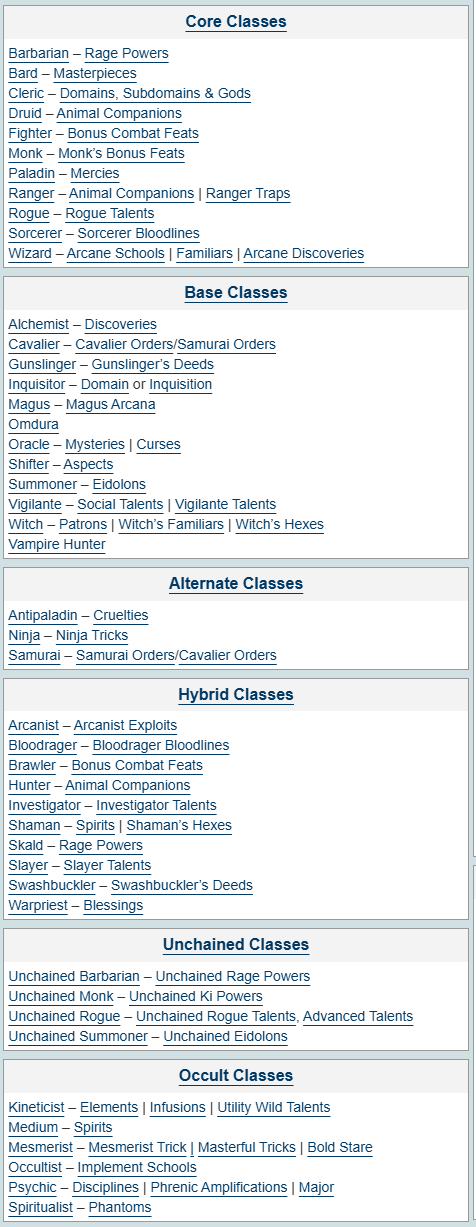
Macris allowed the unwashed masses to pay their way into designing addition character classes for Before all Others. Some of them are pretty obnoxious. Opinions on the role of extraneous or luxury character classes (defined here as classes which exist outside the scope of the big three primary character types which I personally define as fighters, clerics, and magic users) vary greatly. Some OD&D revanchists wish to return to the three class paradigm, whereas pathfinder has at least this many classes…
Kodiak-Game (title pending) is still in the preliminary stages of design but it has only three classes. That being Fighting-man, Magician (Good-aligned magic user), and Sorcerer (Evil-aligned magic user). You may assume then that I am personally a class minimalist which is only partly true. I believe there is nuance to this topic.
A character’s class is the highest possible echelon that can be used to describe them in game world terms. They are very broad classifications. In almost all games the changing of a character’s class is impossible in the explicit text of the rules. They are immutable. It so follows in my mind that you have to be very careful when breaking down high level classes (Fighter) into sub-categories (Barbarian, Paladin, Ranger).
If a class possesses a capability other classes don’t possess, you are implicitly communicating that the circumstance required to acquire said capability is incredibly exclusive. If a character does not choose to cultivate this ability in the nebulous place and time they exist in before becoming level 1, they will never be able to.
In many games, like Pathfinder especially, these classes basically come down to collections of videogame powers and combat optimizations. It goes without saying that is an uninteresting avenue of customization that large portions of the hobby have rejected. I am however sympathetic to players wanting to have a character that does something in particular. You can easily cherry pick a hundred characters from fantasy novels that cannot be replicated 1:1 with any of the existing classes. I think wanting to do that in the first place is maybe not the best practice as player but I can understand wanting the game to have mechanisms that allow unique characters to exist within it.
So why does Kodiak-Game only have three classes? Because adding more classes to the game is not the solution to this problem. Let’s look at an example.
They added a class to Before All Others called the oakheart. Its basically an elf fighter that slowly turns into a treant because someone smeared magic tree sap on them. This is someone’s special snowflake original character concept. Sure, whatever. It’s not really interesting to sit here and complain about someone’s bad taste. Here’s my problem. This is an archetype that creates strange implications at the high echelon of character description that is the class. Why can’t a magician undergo this procedure? Why not a high level character? This is a class that is basically another class with a ritual magic spell cast on it at level one.
When you remove a class from the game you making an implicit assertion that there is no material circumstance in the game world that allows a character to acquire that skill set anymore. I removed thieves from Kodiak-Game. All characters can sneak around at a certain level of proficiency essentially determined by their current equipment and dexterity score. Beyond that I have asserted, implicitly, that characters cannot be trained sneaks in this game. I did this for a variety of reasons (not least of which being that super-duper stealth guy is an essentially silly capeshit archetype but I digress). In kodiak-game there are burglars, but they are not player characters. It’s an NPC only role. It is not a class, burglars are low level fighters with the enumerated ability to do things like crack safes and disarm mechanisms. Removing the thief as a class was not about declaring that thieves were not a part of the game world but that they were not meaningfully distinct from fighters. They were essentially fighting men of low ability with a certain set of skills. Within kodiak-game there is an essential dichotomy wherein you are either a magician or not. That is your class, the highest echelon of your character.
Returning to the oakheart. The way I would implement that sort of character is simply to say that you can begin the game as a fighter with some sort of permanent magical curse or spell placed upon you in exchange for drawbacks, on a game design level not as an assertion of DM dispensation. We have rerouted the way you create this sort of unique character in the diegetic patterns of the game world. These sorts of things could even be acquired after level if the right circumstances are met. This is a mechanic I am developing for Kodiak-Game both in terms of magical curses and spells but also skillsets. You will essentially give up maximum levels in exchange for bundles of skills or enumerated capabilities.
I think it’s important that these sort of distinctions are in the game. If they are not, you’re drawing a line in the sand and saying that there is no distinction between characters capable of this and those that are not. “Thief skills” are one example, but so are things like mounted combat, seafaring, tracking and outdoor skills and so on. I think building new classes to enable that sort of thing is irresponsible and obnoxious on a design level.