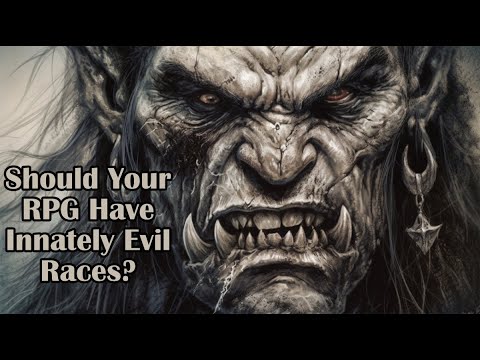
The best RPGs are human-centric. AD&D was human-centric, ACKS is human-centric, so on. The best stories are human-centric, but demi-humans have a part to play in these worlds as antagonists and followers.
Recently I’ve spent some time preparing non-human NPCs of advanced level in ACKS in certain factions and locations which may become relevant soon. Beastmen such as orcs, goblins, gnolls, and so on, creatures like dragons, demi-humans (elves, dwarves), ancient lizardmen… you get the picture. Something that occurs to me is that even in a game as fastidiously designed as ACKS there is a degree of uncertainty when it comes to “leveling up” creatures to serve as leaders or overlords.
One of the oldest and most reliable principles in RPG design is the idea of monsters as a class unto themselves. In this context we define monsters as non-player character antagonists. A human bandit can be described as a “monster” in this definition. Traditionally monsters use the same size of hit die and have the same attack throw progression. So that the number of hit dice a monster possesses becomes the main piece of information necessary to know its capabilities. Its level. This becomes a little more complicated when one factors in things like spellcasting and armor class. If a humanoid monster has a built in AC is that modified when it gains more HD? What if it dons armor? These are grey areas, which isn’t the end of the world. All games will invariably have grey areas.
What I dislike is the implication that classes are diegetic structures that only describe player characters. AD&D is notable for simply describing men at arms as 0th level fighters. Why can’t a goblin be described as a 0th level fighter with goblin characteristics? In ACKS this provides tension when I consider that the “monster” class is stronger per-level than the player fighter class. I dislike the implication that 9th level orcs are empirically stronger than 9th level human fighters. There is an argument to be made here that this reality is offset by the fact that player characters are possessed of ability scores (and proficiencies in the context of ACKS) that abridge this gap, but again I dislike the implication that sapient humanoids such as orcs aren’t also possessed of those things. It may be a suitable abstraction for monsters such as dragons, chimeras, manticores and similar physically powerful beings but it feels imprecise for near-human entities like beastmen, orcs, lizardmen and so on. Similarly to humans, the power of the sapient humanoid races should be their ability to “level up” in a diegetic sense allowing them to gain the power to oppose more intrinsically powerful creatures.
I think constructing classes for your non-human and demi-human races, as well as quasi-classes for important monsters like dragons or giants is a good way to make these creatures more dynamic as opponents without having to invent their capabilities whole cloth. We can now define what the capabilities of an orc look like as it gains “levels” and we can directly compare that to the capability of equivalently experienced human warriors, and so on. Which of course lets you communicate a lot of implicit information about the nature of the gameworld and the non-human creatures that reside in it that players can use to inform their decision making processes. It is fine to say that the bog-standard orc is simply a level 1 or 0 orc with attributes and proficiencies that average to +/- 0, I am not advocating for running up character sheets for each monster. The class would be a tool to scale out more experienced or powerful creatures.
I am not a proponent of necessarily allowing players to play as these classes in a traditional sense, perhaps only suitable in open-table Braunstein type scenarios, nor am I a proponent of generally demystifying the nature of monsters in a given campaign or system. I do think it’s important that the scheme by which you identify the caliber of threats in your game is essentially not calvinball, however.