Themes of Batman's Villains

Plenty of noise is made about Batman’s rogues gallery. Rightfully so! He has the greatest and most recognizable collection of villains of any comic hero. His only rivals are Spider-Man, the Flash, Dick Tracy and perhaps Superman, all trailing behind a considerable distance. For decades now, the discourse surrounding Batman’s villains has been largely the same, about how they’re all supposed to be “sympathetic” and “reflections of Batman” and a lot of this is holds water but this is only true for some of them. Batman: The Animated Series pulled a lot of magic tricks to turn corny and uninspired schmoe characters into classic villains with their own psychologies, which has led many to believe that Batman’s rogues have always been layered and complex. Batman originally fought mobsters: typically Italian crime families, and occasionally fought a costumed maniac. These supervillains ran the gamut from cartoonish pranksters designed to not frighten children like the Riddler or the Penguin and deranged, methodical serial murderers like the original Joker and Clayface.

In the Promised Land DC Universe, which is supposed to be a refinement and a purification of the scrapyard that is DC ideas, I posit that Batman’s (Bruce Wayne’s) main and most important villains number only five: Two-Face, the Joker, Bane, Ra’s Al-Ghul, and Hush. I will explain what makes these versions of the characters work in subsequent posts.

2 Likes

TWO-FACE (Harvey Dent)

The PLDCU Two-Face is very similar to his traditional version. A testament to the strength of the original idea. The most major change is his upgrade from his nowadays “second-rate” statues into archvillain territory.

Harvey Dent is a personal friend and confidante of Bruce Wayne, both having attended college together and running in similar social circles. Bruce detects within Dent, even early in his career as a prosecutor, a zeal for the destruction of the organized crime families that are the de facto rulers of Gotham City. It is why Dent is quickly made an ally of the Batman. Working several high-profile cases, assisted by Batman behind the scenes, Harvey Dent becomes so popular and beloved that he defies the odds in a fixed election to become the District Attorney of Kane County, where Gotham is located. He actually begins making headway, putting away several high-profile mob figures in cases he prosecutes himself, in a showmanlike fashion. This is a problem for the powers that be.

I should mention that Harvey has an undiagnosed case of Disassociative Identity Disorder. He’s probably had it since he was a child. In fact, it’s part of what makes him such a good politician, he is able to compartmentalize the warm and caring family man away from the hard-charging, rule-bending fearless prosecutor. In an unsuccessful assassination attempt, half of Harvey’s face is burned off. The nerves are severed too, giving him a permanent rictus grimace and one yellowing, unblinking bloodshot eye on the left side of his head. In the hospital, Dent’s wife Gilda runs away in shock after seeing him. Reconstructive surgery is scheduled, to be financed by Bruce Wayne, but Dent suffers a total psychotic break and flees the hospital, wounding two orderlies and a nurse. Dent goes into hiding, and not even the Batman can find him. The only trail in the months following is the brutal slaying (half of the time only maiming) of many gangsters, all belonging to the Falcone mob. No one suspects that the serial killer is in fact, the former DA, who has now transformed into something else.

Two-Face is a very personal foe for Bruce’s Batman, and definitely the most tragic and sympathetic of the Major Five. Thematically, he mirrors Batman in a few meaningful ways. His need for vengeance becoming an all-consuming obsession that destroys his life and others’ over and over, his need to become a mythic figure feared by his enemies, which leads to the invention of the Two-Face persona. In contrast to Bruce Wayne, whose trauma gave birth to the Batman persona that lives inside him, and is arguably the “real” him, Two-Face embraces both halves of his soul, which are mutually exclusive and destroy him from within like matter and antimatter exploding.

Harvey’s role as DA was transformed through his trauma into his role as Two-Face. This is why he needed to become what he hated, organized crime, so that he could have the same level of profile and status. This need to be seen, heard, and feared, combined with his obsession with duality and binary justice, gradually gets so psychologically destructive that he becomes a compulsive terrorist, committing seemingly random acts that only can be in the name of justice in his own warped mind. Harvey is a cautionary tale for Batman, and a grim reminder of what Gotham City can do to people with the best of intentions.

2 Likes

THE JOKER

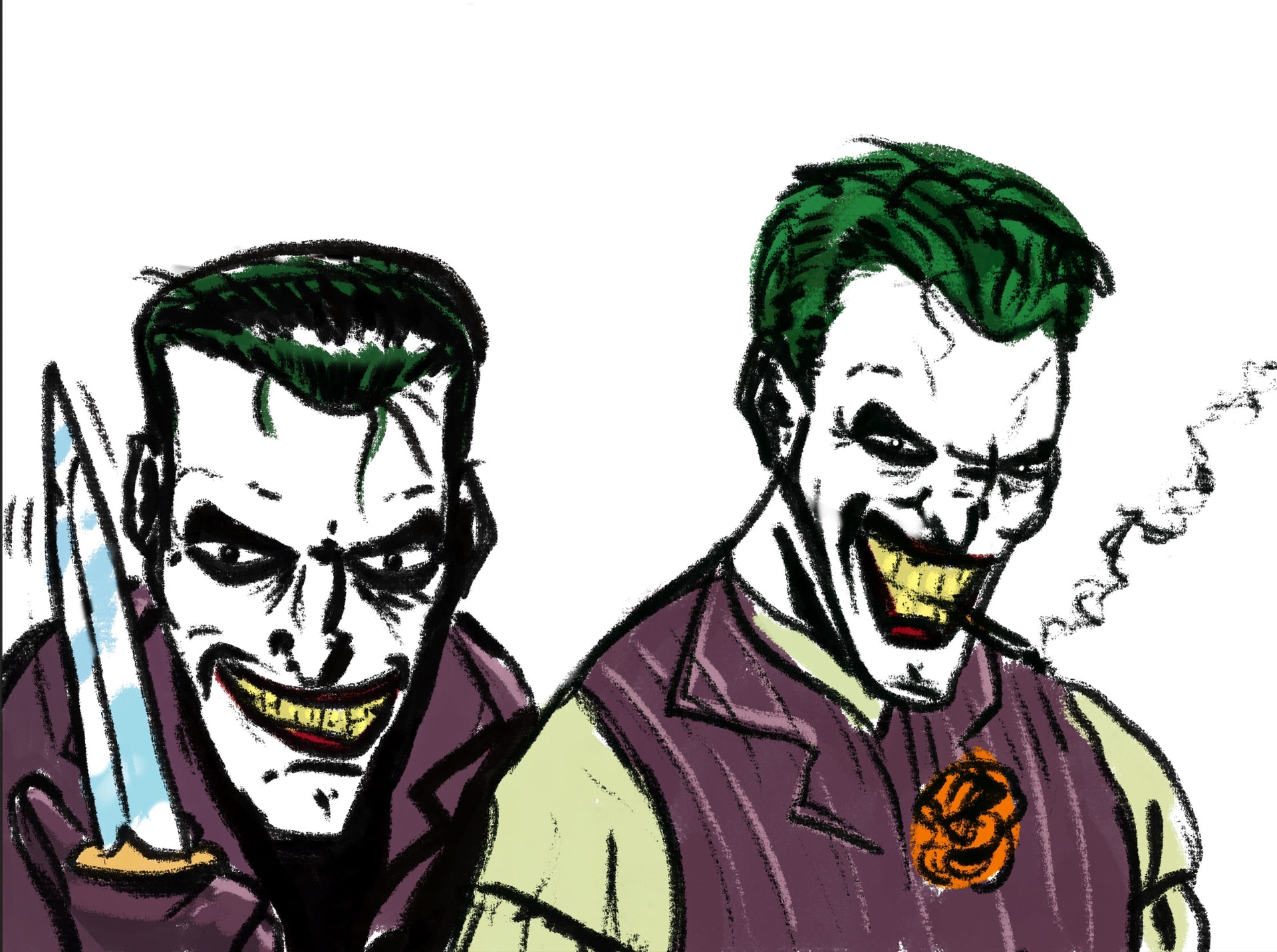
The Joker is a cipher more than he is a man. He seems to represent nearly every negative facet of humanity in the same way Batman embodies virtue. He is narcissistic to the point of literal self-worship. He is sociopathic and psychotic to degrees that exceed the levels of nearly all studied cases. He is petty, vindictive, capricious, cowardly, and downright cruel. What is important about the Joker is that he is never sympathetic or relatable. Any time he deigns to speak about his “tragic” origins, the details are different from the last. Sometimes he was a street tough named Joe Chill. Other times a low-level mob figure named Jack. He told Harleen Quinzel that he was an innocent struggling artist before he was tragically dumped in a vat of toxic chemicals by the bully Batman, a result of a wrong-place-wrong-time misunderstanding. Every time, it’s a lie to get something he wants. His origins don’t matter. Whatever kind of man the Joker was before the accident that disfigured him, the Joker existed within him, waiting for an excuse to get out. He was already a monster. Gotham created the Joker in the same way that it created the Batman.

He is utterly obsessed with the Batman, because his destruction or corruption would mean that there is truly no hope for mankind, and that Joker’s nihilism would be vindicated. Anyone who does business with the Joker dies. Anyone who looks at the Joker the wrong way dies. Anyone who he thinks is laughing at him dies. His favorite method of killing are drugs designed to induce psychosis (which he calls clarity or “getting the Joke”) before the victim convulsively laughs themselves to death, slowly and painfully. He has also been known to flatten victims with dropped anvils and pianos. He returns from seemingly certain death numerous times, which causes the superstitious to believe he is a ghost haunting the city, maybe the incarnation of Death itself. He indoctrinates the already insane into his worldview, building a legion of cultists rather than employees. Several people believe him to be the antichrist. In reality, there is no grand purpose to anything the Joker does. It’s all in service to his own titanic ego.

What sets the PLDCU Joker apart from his modern comic counterpart is that we have removed the sort of reverence and endearing qualities that makes the modern Joker feel more like a schoolyard rival or even unlikely friend/lover of Batman and brought him back to his roots. The Joker is a brutal serial killer with NO redeeming qualities who has zero moral qualms about ANYTHING. The idea of doing good is totally alien to him. Goodness, order and justice make him phyiscally sick because they are violations of everything he believes about himself and the world, which obviously exists FOR him.

The ending for the PLDCU Joker is that he should probably be killed by a jealous and spiteful Harley Quinn, seemingly out of nowhere. I hate the Joker as a person so much that I don’t want him to have the satisfaction of a dramatic duel to the death with his archnemesis. No, you get slimed out by your own former slave. Fuck you, Joker.

2 Likes

I am always a fan of giving Two-Face an excuse to be a legitimately professional costumed criminal. Too much of the time I feel like Batman villains are somehow not good at what they do- if they aren’t good then fine it’s why Batman puts them away so often, but why are we supposed to be afraid of the consequences of their plans then? Silly. Two-Face should be running a tight ship and be represented as consistently disguising or giving enough of a dilemma for his capers that he gets away with them often. Batman’s interruption to his schemes needs to mean something, and Two-Face should have a special animosity for him and the GCPD obviously, it seems rare that we get a scenario where there are consequences for the GCPD with these kinds of villains, who are supposedly skilled enough to evade the cops and just clumsy enough for Batman.

1 Like

I’d be curious to read a take on what should become of Two-Face. Perhaps when he finally self-destructs entirely he should be able to do some good? Maybe the Falcone mob goes down with him? I like the reading of Two-Face as a cautionary tale about indulging vigilante justice.

2 Likes

I don’t know if there’s a happy ending for Harvey Dent. Death might be the release that he’s looking for, and in the end, might satisfy his own sense of justice. Unfortunately I think there’s no recovery for Harvey because he must ultimately bear the weight of what might become of Batman until the bitter end.

Arkham Asylum: a Serious House on Serious Earth shows a Two-Face that has been weaned off of his binary coin toss, and the doctors at Arkham have moved him to use dice and other increasingly complex methods of decision making. The end result of this is a Harvey so paralyzed by his options that he can’t even go to the bathroom to relieve himself. It’s undignified, but definitely tragic.

I think that the warning of Two-Face isn’t against vigilantism in and of itself, but moreso the obsession with punishment, and the hopeless abandonment of seeking real justice and instead careless fate, because it’s more “fair”.

1 Like

BANE

It’s possible that the Batman “identity” was born the night Bruce Wayne’s parents were murdered in front of him, but it is also true that Bruce still had to make the conscious choice to become the hero called Batman. Plenty of things also had to happen for Batman to occur. His family had to be extremely wealthy. His parents had to have instilled in him a sense of justice. He had to live in Gotham City and be invisibly tied to it by blood and identity. He had to be a genius with the genetic potential to become a super-athlete. If Bruce Wayne had been ordinary and middle class, he would have been swept into the foster care system, or taken in by a relative, and if he were lucky, he’d achieve something comparable to a normal, healthy life. But this was not so.

Bane, by contrast, represents a man who was forced to become a living weapon to merely survive. He might be one of the only characters in the PLDCU to rival Batman in sheer drive or tenacity. His will to power is unimaginably strong. Bruce Wayne’s formative trauma occurred when he was eight years old, after already experiencing part of a healthy childhood and having loving parents. Bane was born in a military prison, more than likely a child of rape. He was raised in an environment populated by the most violent elements of humanity. He was never a normal human being. While Bruce used his vast resources to pick and choose the finest teachers the world over to become the ultimate fighting/detecting machine, Bane is the complete opposite. From birth, like a shark, he had to learn the hard way to claw and swindle and intimidate and kill for what he needed to just live another 24 hours. Peña Duro functioned as a Darwinian laboratory, and over time Bane became the smartest and strongest rat. By the time he was 17, when his army of prisoners rioted and murdered every guard and official on base, merely to cover his escape, he had been forged into an actual alpha of the species, an apex predator.

Batman had to seek the way to become dangerous. Bane was turned into a weapon by his own existence.

Naturally, this creates an interesting worldview within Bane. He applies “survival of the fittest” to every aspect of life. To Bruce, money and power are a means to help others and right wrongs. To Bane, they are simply methods to feel secure. Both men are driven by a desire to never feel helpless again. Everything to Bane is hierarchy. There are two reasons why he cripples Batman instead of killing him:

  1. He realizes Batman is a creature like him but he doesn’t consider him an equal. He can’t, because of his very nature. Bane cannot acknowledge an equal because that is a defeat! Because of this hubris, he is incapable of predicting that Batman would be driven enough to actually come back stronger.

  2. To humiliate him. He realizes that death isn’t defeat for Batman, and that the knowledge that he still lives and that his mission of vengeance goes unfulfilled is a fate worse than death. Lions and wolves don’t kill their rivals either, they leave them alive to establish hierarchy (this might be false but Bane is a weird guy who believes in weird stuff, shoot me).

The PLDCU Bane cripples Batman and kills Jason Todd in front of him. This is a change necessary to give more weight to Bane and boost him back up to true archvillain territory.

“I have broken both of your arms. Your legs. Three of your lower vertebrae are shattered. Your neck is broken. I have fractured your skull, your collarbone. You will never fight again. And yet you live. This is by my design. I have established your place in the hierarchy. The pain you feel is nothing compared to what I will inflict upon your city. You will know helplessness. Now you shall watch while I kill your son.”

— Bane

The frustrating thing about liking Bane is that he is the ultimate victim of Potential Man syndrome. In his debut appearances he holds his own against Batman in single combat, aura farms with his Doc Savage-esque goon squad, blows up Arkham Asylum and releases all of Batman’s foes, figures out Batman’s identity, breaks into the Batcave, nearly kills Alfred, and paralyzes a fatigued Batman by breaking his back over his knee in an iconic but underwhelming splash page. Since then, he has done absolutely nothing of interest in canon. He should be drinking buddies with Kraven the Hunter at the “Peaked Once in the Eighties” dive bar. Lately, Bane is usually a henchman to a more prominent villain. This is a poor use of him and more a testament to his striking design rather than any real understanding of what the character means. He is thought of more as a super-powered hulking brute and not the sort of thriller-novel meticulous ruthless gangster I think he should be. That said, Absolute Batman has the coolest and scariest Bane seen in a long time, but he belongs in that world, not this one.
2 Likes

In this way we can understand that Chris Nolan was wiser than we ever suspected. Do you feel in charge?

2 Likes

I really like Nolan’s Bane in retrospect. The villains are pretty strong in those movies

1 Like

Bane is a testament to how badly these characters can become pigeon holed. Its a radical transgression to just give these characters something to actually do. He really is the guy who broke batman’s back. How does he end up as a henchmen when he touched batman in a way that all these other villains couldn’t? Vigilantes fixes this…

2 Likes

ADDENDUM:

They use the Joker too damn much. This is why he has become so watered-down and they have to warp him beyond recognition to make him even remotely interesting. He is shoehorned into stories that shouldn’t involve him. He should be a true heavyweight contender, a guy who doesn’t show up too often but when he does, he makes a real impact.

1 Like